
essay
How to become a robotics engineer in 2027: a roadmap built from job postings
Choose a robotics role, build the skills it asks for, and show the work. A practical roadmap with checked job examples, project ideas, and posted pay.
- robotics
- careers
- engineering
To become a robotics engineer, pick a specific role, learn the skills its job postings ask for, and build a project that demonstrates those skills. Software-heavy roles often involve Python or C++, Linux, robotics fundamentals, and testing. Hardware, research, and operator roles have different entry requirements.
The 12-month plan below is a suggested study schedule for someone who already programs and can devote 10–12 hours a week. It is not a measured time-to-hire estimate. Adjust the pace to your starting point, access to equipment, and the requirements of your target role.
Why consider robotics now?
Robotics includes an established industrial sector as well as newer humanoid and robot-learning companies. The International Federation of Robotics reported 542,000 industrial robot installations in 2024 and 4.664 million industrial robots in operation, in its World Robotics 2025 release. Those are industrial deployment figures, not a count of humanoids or open jobs.1
Learning resources are also accessible. Modern Robotics offers a free preprint, exercises, videos, and accompanying software. NVIDIA's free physical AI courses include an introductory Isaac Sim course and an SO-101 sim-to-real workflow.23
That gives you ways to study and build before joining a robotics company. It does not make hiring predictable. Choose work you want to understand deeply enough to keep improving it when the market is less enthusiastic.
Ten kinds of work behind a robot
Pick a row before you pick a course. These categories overlap, and companies use different titles for similar work. Operator and technician roles belong in the map because they keep robots working, though they are different jobs from engineering positions.
| Role | What you work on | Skills to investigate |
|---|---|---|
| Robot learning engineer | Policies learned from demonstrations or experience | PyTorch, imitation learning, reinforcement learning, real-robot evaluation |
| RL / whole-body control engineer | Learned movement, balance, recovery | Dynamics, simulation, policy training, sim-to-real |
| Robotics software engineer | Software connecting sensors, planning, and actuation | C++, Python, Linux, ROS 2, testing |
| Controls engineer | Turning desired motion into controlled physical behavior | Dynamics, feedback control, state estimation, real-time implementation |
| Perception engineer | Estimating objects, motion, and geometry from sensors | Computer vision, calibration, probability, localization |
| Simulation engineer | Virtual systems for development and evaluation | Physics modeling, simulation tools, scenario design, validation |
| Deployment / forward deployed engineer | Getting systems to work at customer sites | Integration, debugging, Linux, networking, customer communication |
| Robotics tooling engineer | Software used around the robot | Web or mobile development, data pipelines, operator interfaces |
| Mechanical / hardware engineer | Mechanisms, actuators, structure, manufacturing | CAD, mechanics, electronics, hardware testing |
| Robot operator / technician | Daily operation, maintenance, issue reporting | Troubleshooting, equipment procedures, reliability, safety |
The differences become clearer in actual requirements:
- Figure's robot-learning role asks for hands-on deployment of learning systems on real robots, manipulation experience, and Python and/or C++. It lists publications as a bonus.4
- Its Android role asks for six years or more shipping consumer Android apps, Kotlin, Jetpack Compose, and mobile-platform leadership. This is experienced software work inside a robotics company.5
- Its deployment role asks for an engineering degree, 3–5+ years in automation or robotics integration/deployment/development, and frequent travel between headquarters and customer sites.6
- Its operator role asks for robot or mechanical troubleshooting experience, sustained attention, safety procedures, and up to 75% travel. No degree requirement is listed.7
None of those examples establishes a universal entry requirement. Each tells you what evidence one employer wants for one job.
Choose a path from your background
If you're a student
Compare courses and lab opportunities with the roles that interest you. Computer science can support software and learning work; mechanical engineering can support mechanisms and dynamics; electrical engineering can support embedded systems, sensing, and electronics. A robotics degree may combine these, but inspect the actual curriculum.
Join a team or lab where you can finish something and explain your contribution. A working subsystem, a test you designed, or a failure you traced makes an internship conversation more concrete.
If you're a software engineer
Keep your strengths in debugging, testing, APIs, data pipelines, and distributed systems. Compare tooling, fleet software, simulation infrastructure, and deployment postings before assuming you need to become a robot-learning researcher.
Figure's Android example shows that mobile-platform experience can be directly relevant. It also shows why reading the whole posting matters: the opening is for a lead, not a beginner learning Kotlin.5
If you're an ML engineer
Your model training, data, and evaluation skills can transfer. Add coordinate frames, kinematics, sensing, and the consequences of acting repeatedly in a changing physical environment. A robot-learning project needs an evaluation in which the policy's actions affect the next observation.
Figure's learning role is a useful example of that end-to-end scope: collecting robot data, training policies, analyzing failures, and deploying them.4
If you're a mechanical or electrical engineer
Start from the subsystem you understand: mechanisms, actuators, electronics, sensing, or control. Add enough software to automate measurements and connect your work to a larger robot system. Your target posting should determine whether to prioritize C++, Python, ROS 2, or a different toolchain.
If you don't have a degree
Read the requirements rather than ruling yourself out by title. The Figure operator example has no stated degree requirement, but it does require relevant troubleshooting experience and substantial travel.7
Operator work can provide exposure to real systems. Moving from operations into engineering still requires the skills and evidence of the engineering role; it is not an automatic promotion path.
Build the foundations your role needs
Programming and Linux
For software-heavy robotics, learn to write, test, build, and debug programs. Python is useful for experiments, data, and tools; C++ is relevant where the chosen stack requires it. Practice Git, build tooling such as CMake, logs, processes, permissions, and networking alongside the language.
Avoid making both languages a prerequisite for every job. Figure's learning posting accepts Python and/or C++, while its Android posting emphasizes Kotlin.45
Math and robot motion
Learn the calculation alongside the physical question it answers. Figure's perception posting, for example, asks for probability, optimization, linear algebra, and geometric computer vision.8 The existing lessons on this site give you small examples to inspect:
- Coordinate frames and rotation matrices: describe the same object from different viewpoints.
- Conditional probability: reason about uncertain observations.
- Jacobian matrices: connect joint motion to end-effector motion.
- Feedback control and PID control: understand how measurements change a command.
- Wheel odometry: estimate motion from wheel movement and examine the assumptions.
For a longer sequence, Modern Robotics covers rigid-body motion, kinematics, dynamics, planning, and control. Its prerequisites include first-year physics, linear algebra, differential equations, and some programming. Use its exercises to identify gaps rather than collecting more course titles.2
ROS 2
For roles that use ROS 2, study nodes, topics, services, actions, transforms, launch files, and recorded sensor data. Build a system with several components so that you have to debug communication between them.
Lyrical Luth was released in May 2026 and has support through May 2031. Its Tier 1 platforms include Ubuntu 26.04 and Windows 11. It is a reasonable starting point for a compatible new project; check your robot drivers, simulator, and course requirements before selecting a distribution.9
Simulation and learning
Choose simulation tools around a task and your available computer. NVIDIA lists its introductory Isaac Sim course at 2–3 hours and its SO-101 sim-to-real workflow at 6–10 hours. Those are course estimates, not the full cost of setting up hardware, collecting data, or becoming proficient.3
For a robot-learning track, study imitation learning, reinforcement learning, and evaluation after you can explain the task's observations and actions. For deployment or tooling, a reliable test harness or data inspection tool may be a better project than training a policy.
A 12-month roadmap, with different tracks
Use the months as planning blocks. This assumes you already program and have roughly 10–12 hours a week. If you are starting from zero, give programming and math their own preparation phase. Advance when you can demonstrate the outcome, even if the calendar moves.
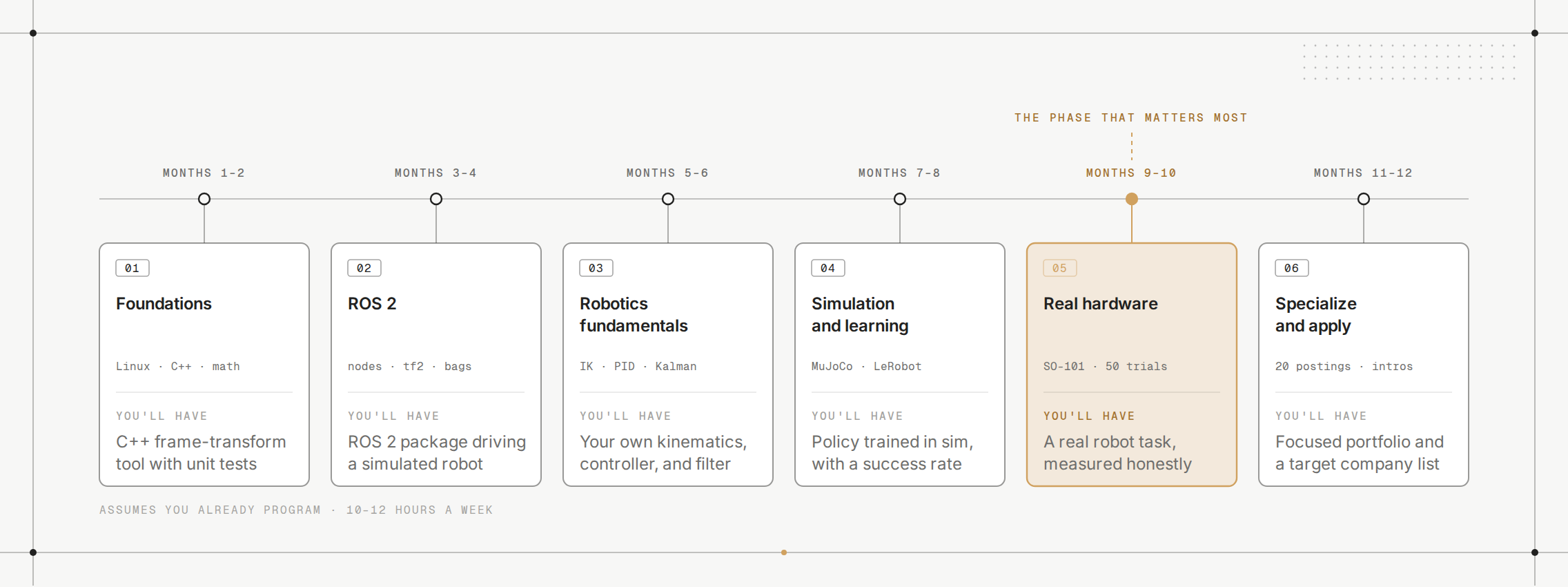
The illustrated track is a robot-learning example. Hardware is especially relevant for that track; software, deployment, and controls alternatives are described below. The image's 50-trial target is a suggested project exercise, not a hiring or safety standard. Open the full-size roadmap.
Months 1–2: Foundations
Get comfortable with Linux and Git. Fill the language gaps your target roles expose. Refresh vectors, rotations, and transforms, and practice writing tests for calculations whose answer you can check by hand.
Show: a small program that reads sensor-style data, transforms it between coordinate frames, and tests both expected inputs and mistakes in units or conventions.
Months 3–4: Build a connected system
For a ROS-based path, work through nodes, topics, services, actions, transforms, launch files, and bags. Drive a simulated mobile robot, record observations, and replay them. For a tooling path, build a viewer or interface around recorded robot data.
Show: a runnable package or application, a short demonstration, and a README that another person can follow. Document a failure you diagnosed across components.
Months 5–6: Explain the behavior
Implement forward and inverse kinematics for a simple arm, or study a mobile robot's motion estimate. Add a controller or estimator that fits your project. Compare the output with a reference calculation and plot where it differs.
Show: tests, plots, the assumptions behind the model, and a case where those assumptions fail. The learning library can supply prerequisites; the project should make you use them together.
Months 7–10: Choose a track
| Track | Build toward | Evidence to retain |
|---|---|---|
| Robotics software / deployment | A ROS system with logging, replay, and reproducible failures; test on accessible hardware where practical | A bug report, regression test, timing measurements, setup instructions |
| Robot learning / simulation | A bounded manipulation task; collect demonstrations, train a policy, evaluate unfamiliar conditions | Data splits, trial definitions, success and failure counts, sim-to-real differences if tested |
| Hardware / controls | A mechanism or control experiment you can characterize; compare predicted and measured behavior when hardware is available | Calibration procedure, tracking error, operating limits, model mismatches |
| Tooling / data / fleet | A viewer, data pipeline, or monitoring tool for recorded robot data | A usable workflow, validation tests, replayable inputs, feedback from a user |
If you choose the SO-101 learning path, budget for a complete setup. Hugging Face's assembly guide distinguishes the follower arm from the leader used for teleoperation. Check the current bill of materials, cameras, power supplies, printing, and computing requirements. A quoted price for one arm is not the price of the whole experiment.10
For a small task, you could plan 50 evaluation trials, define success in advance, and report every attempt. This proposed exercise cannot establish general reliability. Keep evaluation conditions separate from training and tuning; state how often a human resets or intervenes. Follow equipment safety instructions and work within an appropriate supervised setup.
Show: one result another person can inspect or reproduce, with a clear limit on what it establishes.
Months 11–12: Specialize and apply
Return to current job postings. Identify gaps between your project and the work you want to do, then choose one focused improvement. Ask someone in the field to review your README, test method, or design decision.
Apply where you can demonstrate relevant work. Keep building and getting feedback while you apply; course completion alone does not establish readiness for a particular vacancy.
Five portfolio projects that prove specific skills
Each project should have a question, a reproducible setup, and a result. Pick the one that matches your intended role.
| Project | Useful for | A concrete finish line |
|---|---|---|
| Kinematics and control from scratch | Controls, planning | An IK solver checked against a reference, with errors and failure cases |
| A ROS 2 system with a failure you fixed | Robotics software, deployment | Recorded inputs that reproduce a bug, plus a regression test for the fix |
| A sim-to-real policy | Learning, simulation | Comparable task results in simulation and on hardware, with differences explained |
| Imitation learning on an SO-101 | Robot learning, data | Documented demonstrations, held-out evaluation, and a failure breakdown |
| A robot-data or monitoring tool | Tooling, data, fleet | A workflow another person can run on supplied data, with validation tests |
Put the problem, your contribution, and the result near the top of the README. Include a short video if behavior is hard to convey in a plot. State what failed and what you would test next.
An honest success rate needs a denominator and conditions. Explain the task distribution, resets, interventions, and which trials you excluded, if any. A polished video cannot provide those details on its own.
Do you need a degree?
There is no single answer across robotics roles. In the checked sample:
- Robot learning: Figure requires experience deploying learning systems on real robots. It lists publications as a bonus and has no explicit degree requirement.4
- Deployment: Figure explicitly asks for an engineering degree and 3–5+ years of relevant work.6
- Android: Figure emphasizes six years or more of shipping consumer apps and platform leadership.5
- Operator: Figure lists troubleshooting experience, travel, and physical requirements, without specifying a degree.7
An absent degree requirement is not evidence that a role is entry-level. Equally, one employer's degree requirement cannot tell you what every company will accept. Compare several postings for the same kind of work and read required versus preferred qualifications carefully. For research-scientist positions, inspect the specific research and education requirements separately from this applied-role sample.
What the posted pay tells you
These are selected Figure postings checked September 22, 2026, all with San Jose, California listed as the location. The operator role involves substantial travel. Engineering figures are annual US base ranges; the operator figure is hourly. Equity, benefits, and any overtime are not included.
| Posting | Experience / employment context | Posted base compensation |
|---|---|---|
| Helix AI Engineer, Robot Learning | Full-time; hands-on deployment of real-robot learning systems required | $200,000–$400,000 per year4 |
| Helix AI Engineer, Android | Full-time; lead role, six years or more of consumer Android experience | $200,000–$400,000 per year5 |
| Humanoid Robot Operator, Commercial Launch Team | Described as contract-to-hire; up to 75% travel | $30/hour7 |
The operator posting describes contract-to-hire employment and also calls the quoted rate a full-time base hourly rate. Ask the recruiter to clarify hours, benefits, overtime, and conversion terms. The table preserves the hourly unit rather than implying a guaranteed annual salary.
These examples show how different the jobs are. They cannot establish a typical robotics engineer salary, entry-level pay, or a ranking of which specialization pays best. One high-paying Bay Area employer is a particularly narrow sample. Compare offers by location, level, responsibilities, total compensation, and employment terms.
How to approach the job search
Read postings as specifications
Collect a set of current postings for your chosen role. Record the company, location, date checked, required experience, degree wording, and repeated tools. Keep the original links. Requirements that repeat can guide your curriculum; a less common requirement may still be essential to a particular job.
Separate software engineering at a robotics company from engineering the robot's behavior. Both are legitimate paths, but they ask for different portfolios. Figure's Android and robot-learning openings make that distinction concrete.54
Ask for specific feedback
Contact people whose work overlaps your project. A question about an evaluation method, a driver issue, or a reproducible failure gives them something they can assess. A request to inspect one result is easier to answer than a request to explain an entire career.
Use introductions, meetups, and technical communities where you can participate genuinely. Do not assume a particular channel guarantees a reply.
Stage a career change around evidence
If you are employed, build projects and conversations alongside your current work where feasible. Set a review date for the plan. Reassess your finances, role requirements, and project evidence before making a major change. A learning schedule cannot make that decision for you.
Mistakes to avoid
- Staying in tutorial mode. After a tutorial, change a condition, predict the outcome, and explain what happened.
- Treating all roles as robot learning. A deployment test or operator tool may fit your target better than a trained policy.
- Hiding the boundary of a simulation. Explain which hardware effects you model and which remain untested. Seek hardware access when the intended role calls for it.
- Skipping software fundamentals. Make the project reproducible, testable, and debuggable.
- Showing demos without conditions. Include trial counts, failures, and interventions alongside the video.
- Reading a salary range as an entry offer. Check the experience requirements before comparing numbers.
- Waiting for a universal readiness threshold. Match evidence to particular openings, apply, and use the feedback to choose what to improve.
Frequently asked questions
How long does it take to become a robotics engineer?
There is no reliable single timeline. This guide proposes 12 months at 10–12 hours a week for someone who already programs to develop foundations and a focused portfolio. A beginner will need additional preparation. Completing the plan does not guarantee an offer or satisfy every role's degree and experience requirements.
Can I become a robotics engineer without a degree?
Some postings do not specify a degree. Figure's checked robot-learning role is one example, but it still requires hands-on experience with real robots. Its deployment role explicitly asks for a degree. Evaluate the role's requirements rather than assuming one answer applies everywhere.46
Should I learn Python or C++ first?
Python is a practical starting point for scripting and experiments if you are new to programming. Add C++ when your target stack requires it. For mobile tooling or mechanical work, another language or skill may deserve priority. Start with the job and project you want to pursue.
Can I learn robotics without buying hardware?
You can study math, software, simulation, and data workflows without owning a robot. A physical robot adds evidence for roles that require hardware experience, but buying an arm is not a prerequisite for every robotics-related job. Consider lab, team, or shared-equipment access before purchasing.
Is robotics a good career for 2027?
It offers several kinds of work, from software and research to integration and operations. Industrial deployment data establishes that robots are in use at scale; it does not forecast your hiring chances. Choose a role that fits your interests and constraints, then check actual openings in locations where you can work.1
What's a useful first robotics project?
For robotics software, build a small ROS 2 system in simulation and document a bug you fixed. For a tooling background, build something useful around recorded robot data. Choose a small enough scope that you can finish, test, and explain it.
How much do robotics engineers make?
Pay depends on location, role, seniority, and company. The checked Figure examples list $200,000–$400,000 annual base ranges for experienced robot-learning and Android roles, and $30/hour for the operator role. This small sample is not a market salary estimate.457
Your next step
Choose one role, read several current postings, and write down one project that would demonstrate a requirement you currently lack. If the gap is robot motion or estimation, start with the interactive robotics lessons. If you want to follow the research and tools as they change, read Robotics Briefing.
Found a changed posting or a technical mistake? Send a correction. Include the claim and a source so the guide can be checked and updated.
Footnotes
-
International Federation of Robotics, World Robotics 2025: Global Robot Demand in Factories Doubles Over 10 Years, September 25, 2025. Reports 2024 industrial robot installations and operational stock. Checked September 22, 2026. ↩ ↩2
-
Kevin Lynch and Frank Park, Modern Robotics: Mechanics, Planning, and Control. Textbook, free preprint, exercises, prerequisites, and software. Checked September 22, 2026. ↩ ↩2
-
NVIDIA, Physical AI Learning. Free courses and provider-estimated durations; equipment and compute requirements depend on the course. Checked September 22, 2026. ↩ ↩2
-
Figure, Helix AI Engineer, Robot Learning. San Jose; real-robot experience required; no explicit degree requirement; $200,000–$400,000 annual base range. Checked September 22, 2026. ↩ ↩2 ↩3 ↩4 ↩5 ↩6 ↩7 ↩8
-
Figure, Helix AI Engineer, Android. San Jose; six years or more of consumer Android experience; $200,000–$400,000 annual base range. Checked September 22, 2026. ↩ ↩2 ↩3 ↩4 ↩5 ↩6 ↩7
-
Figure, Deployment Engineer, Commercial Sites. Engineering degree, 3–5+ years of relevant experience, Linux and Python or other coding languages, frequent travel. Checked September 22, 2026. ↩ ↩2 ↩3
-
Figure, Humanoid Robot Operator, Commercial Launch Team. San Jose; contract-to-hire description; up to 75% travel; $30/hour; no explicit degree requirement. Checked September 22, 2026. ↩ ↩2 ↩3 ↩4 ↩5
-
Figure, Helix AI Engineer, Perception. Mathematical foundations, geometric computer vision, and production software experience. Checked September 22, 2026. ↩
-
Open Robotics, ROS 2 Lyrical Luth release announcement, May 22, 2026. Support through May 2031 and platform tiers. Checked September 22, 2026. ↩
-
Hugging Face, SO-101 assembly guide. Leader/follower hardware, bill-of-materials reference, and assembly instructions. Checked September 22, 2026. ↩